
The OECD Just Proved Most AI Study Apps Are Making You Dumber — Here’s Why We Built Ours Different
A massive international report dropped. Nearly 1,000 students were studied. The findings? Students using ChatGPT-style AI scored 48% better on practice — then 17% worse on the real exam. Let’s break down what happened, why it matters, and what actually works.
📖 9 min read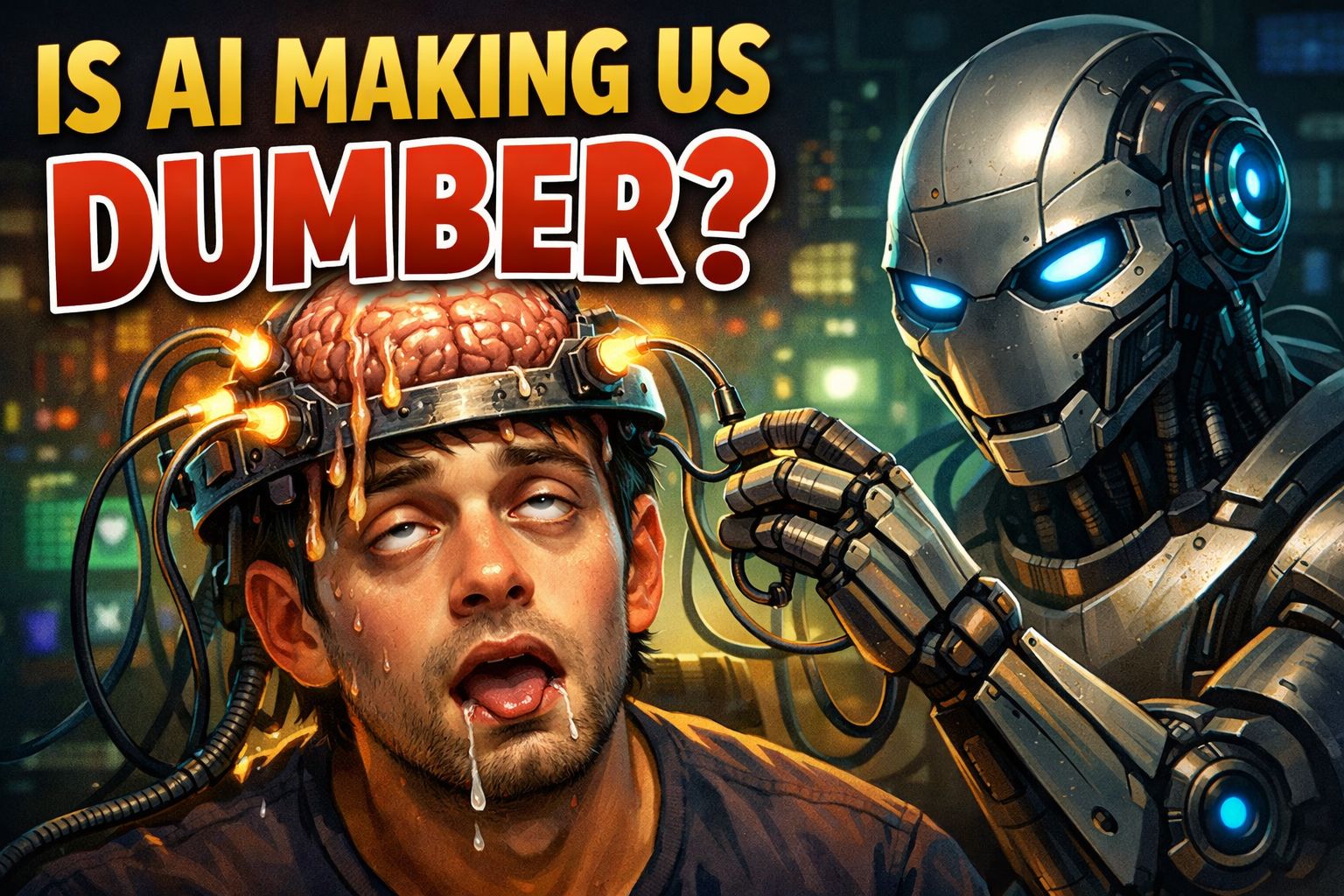
Okay. We need to talk about this.
The OECD — the Organisation for Economic Co-operation and Development, a.k.a. the body that 38 of the world’s most developed nations trust to set policy on education, economics, and trade — just published their Digital Education Outlook 2026. It’s a landmark report. Hundreds of pages. Years of research. And the headline finding is one that should make every student using ChatGPT as a study buddy stop and pay attention.
Here’s the short version: AI can make you feel like you’re learning while actually making you worse at the thing you’re studying.
And if you’re preparing for a licensing exam, a certification, a board review — anything where you walk into a room, sit down, and have to know it cold with no help — this research is directly about you.
Let’s break it all the way down.
48% Better at Practice. 17% Worse on the Test.
The OECD’s report draws heavily on a field experiment run by researchers at the University of Pennsylvania in collaboration with a high school in Turkey. The study, later published in the Proceedings of the National Academy of Sciences (PNAS), tested nearly 1,000 high school math students across four 90-minute sessions.
Three groups. Same curriculum. Different tools.
Group one got textbooks and notes — the old-school control. Group two got a standard ChatGPT-style interface powered by GPT-4 — basically, “ask the AI anything.” Group three got a specially designed AI tutor that used guardrails: it was programmed to give hints and ask guiding questions instead of just handing over the answer.
During practice? The AI groups crushed it.
practice scores
practice scores
real exam scores
Read those numbers again. The students using plain ChatGPT got 48% better scores on practice problems while the AI was available. The guided tutor group? An astonishing 127% improvement.
But here’s where it gets ugly.
When the AI was taken away and students sat a closed-book exam, the ChatGPT group performed 17% worse than the students who never had AI at all. They didn’t just lose their advantage. They were actively worse off than if they’d never touched the tool.
Why “Just Ask the AI” Is a Trap
The researchers had a term for what happened to the ChatGPT group: the crutch effect. Students outsourced the thinking to the machine. Instead of struggling through a problem — which is where learning actually happens — they asked the AI, got the answer, moved on, and felt great about it.
The OECD’s own analysis describes this as “metacognitive laziness.” Students stopped monitoring their own understanding. They stopped asking themselves “do I actually know this?” Because the AI made every practice session feel easy, they developed false confidence. The OECD report found that students who used generic AI tools were actually overly optimistic about their own abilities — they thought they were doing great, even as their actual knowledge was eroding.
Here’s the uncomfortable truth: most AI study apps on the market right now are answer engines. You ask, they answer. That’s it. And according to this research, that design pattern doesn’t just fail to help you learn — it actively makes you worse at the thing you’re trying to master.
The “Guided Tutor” Model — and Why It Changes Everything
Here’s the part of the study that doesn’t get enough attention.
That third group — the ones using the AI tutor with guardrails? They didn’t suffer the 17% penalty. Their exam scores were statistically identical to the control group. They kept up. And during practice, they blew everyone away at 127%.
What was different? The AI tutor didn’t give answers. It was designed to guide students through the problem with hints and follow-up questions. It would check their reasoning. Nudge them toward the right approach. Force them to do the cognitive work themselves.
The researchers found that students using the guided tutor spent 13% more time on problems than the ChatGPT group. They asked twice as many questions per problem by the fourth session. And critically, their conversations with the AI were classified as “non-superficial” — meaning they were actually engaging with the material, not just requesting answers.
The OECD’s report highlights this as the key design principle for educational AI: intelligent tutoring systems that use techniques like Socratic questioning to develop both subject knowledge and critical thinking are far more promising than open-ended answer engines.
The Missing Piece: Why Game Mechanics Make Retention Stick
The OECD report tells us how AI should coach. But there’s a second body of research that tells us how students should practice — and it points straight at gamification.
Here’s what the data says: active recall under pressure produces retention rates 3 to 8 times higher than passive review. That’s not opinion. That’s decades of cognitive science research on retrieval practice — the act of pulling information out of your brain rather than putting it in.
And gamification is one of the most effective delivery systems for retrieval practice ever designed. Timed challenges. Point systems. Leaderboards. Streaks. High-stakes modes where one wrong answer ends your run. These aren’t gimmicks. They’re behavioral psychology frameworks that create exactly the conditions your brain needs to consolidate long-term memory.
The numbers back it up: research compiled in 2026 shows that gamified e-learning programs achieve a 90% completion rate compared to just 25% for traditional non-gamified programs. A longitudinal study with over 600 students found gamification had a measurable positive impact on knowledge retention across age groups. And the global game-based learning market has become one of the fastest-growing segments in all of EdTech — because it works, and institutions know it.
The Industry Is at a Crossroads
The OECD report isn’t anti-AI. Far from it. Their central message is that generative AI can be a powerful ally for education — but only when guided by pedagogy, not convenience.
The report makes clear that AI is already deeply embedded in education. Among teachers who use AI, 68% are using it to research or summarize teaching topics, and 64% are using it to generate lesson plans. AI isn’t going away. It’s accelerating. The question is whether the tools being built are designed to make students look smarter or actually become smarter.
And that question matters more for exam prep than almost any other use case. Because when you sit for your licensing exam, your board review, your certification — there is no AI in the room. It’s just you, the questions, and everything you retained. If your study tool trained you to perform with AI support instead of building knowledge you own independently, you’re walking into that exam at a disadvantage.
The OECD calls it the difference between “performance at educational tasks” and actual learning — the acquisition of knowledge and skills that persist when the tool is taken away. And that distinction is the single most important thing any student preparing for a high-stakes exam can understand right now.
How to Tell if Your AI Study Tool Is Actually Teaching You
Based on this research, here’s what separates tools that help from tools that hurt:
Does it make you think, or does it think for you? If you can paste a question and get a complete answer in one step, that’s an answer engine. A real AI tutor will push back, ask follow-up questions, and make you work for it.
Does it track your weaknesses over time? A one-off answer tells you nothing about your learning trajectory. Effective tools remember what you got wrong last week and circle back to it — again and again — until you’ve genuinely mastered it.
Does it create exam-like pressure? The brain encodes information differently under stakes. Timed challenges, high-stakes modes, and competitive elements aren’t luxuries. They’re how you simulate the conditions you’ll face on test day.
Can you use it hands-free? Passive scrolling through flashcards while half-watching Netflix is not studying. Voice interaction forces engagement. When a coach is speaking to you, reading questions aloud, and expecting a response — you can’t zone out.
Does it feel like a game or a chore? Completion rates don’t lie. If you’re forcing yourself to open the app, the tool has already failed. If you lose track of time because the experience is immersive and rewarding, that’s retention compounding in real-time.
Designed to Make It Stick.
Cameron Academy’s AI exam prep combines guided voice coaching, multi-tiered hints, gamified exam modes, and long-term performance tracking — the exact formula the research says works.
Start Your Free TrialNo credit card required · Cancel anytime
TL;DR — What You Need to Know
The OECD’s 2026 Digital Education Outlook is a wake-up call. AI in education is not inherently good or bad — it’s entirely dependent on design. Generic AI tools that act as answer engines can create a false sense of mastery while actively undermining the deep learning you need for exam day. Purpose-built AI tutors with pedagogical guardrails — tools that coach, question, and guide rather than simply answer — preserve learning while dramatically improving engagement.
Layer in gamification — timed challenges, achievement systems, high-stakes modes that simulate real exam pressure — and you get a retention engine that passive study apps simply can’t match.
That’s not marketing. That’s what the research says. And it’s exactly what we built Cameron Academy to be.