
9 Study Hacks Nobody Talks About
(Backed by Science You Can’t Ignore)
A major meta-analysis rated the most popular study methods as the least effective. Re-reading? Low utility. Highlighting? Low utility. The techniques that actually work? Almost nobody uses them. Here’s what the research says — and why it should change how you study tonight.
📖 12 min read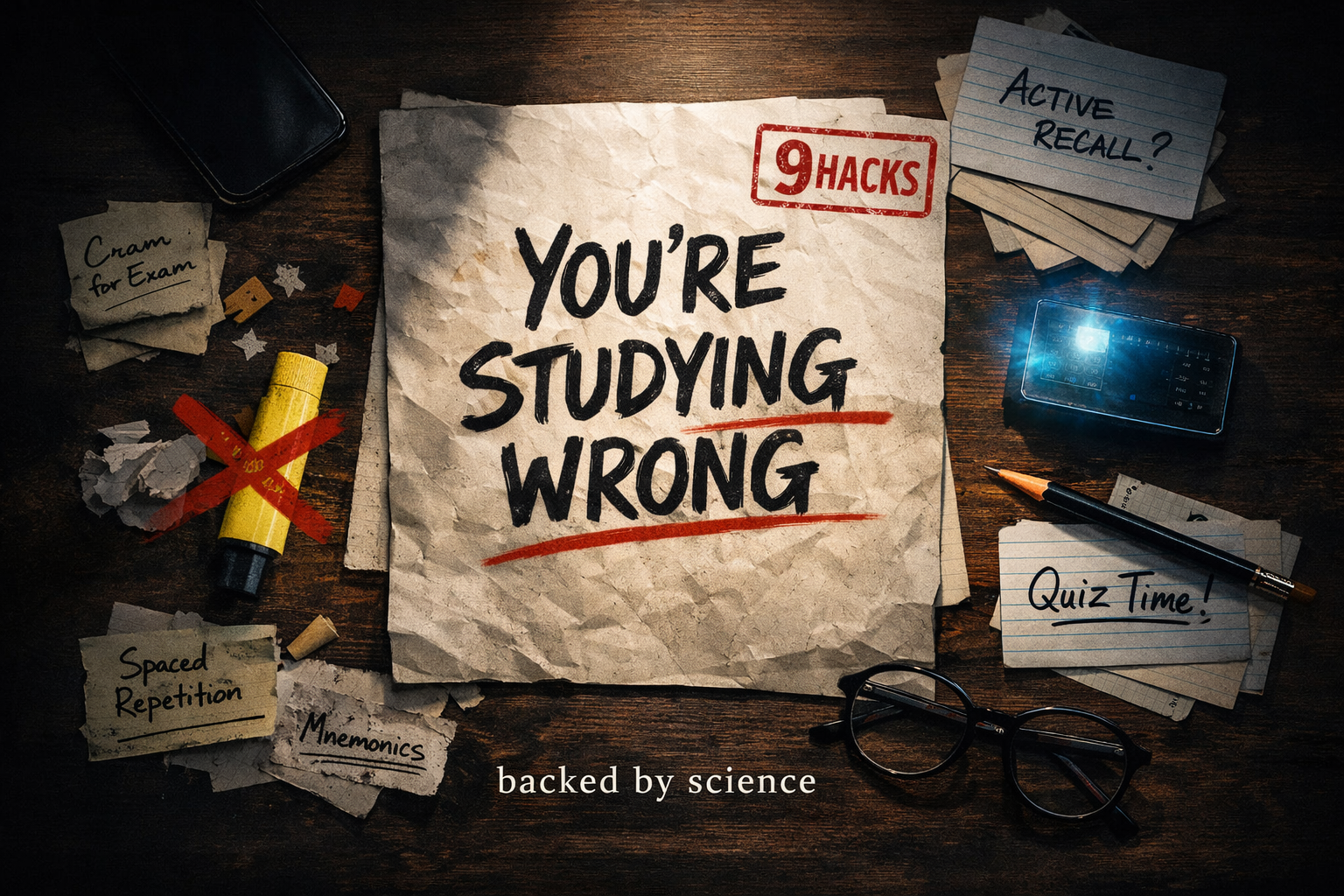
Okay, real talk.
I’ve been neck-deep in the latest learning science research for weeks — reading published studies, cognitive psych papers, real peer-reviewed data — and I keep having the same reaction over and over: why did nobody teach us this in school?
A massive meta-analysis by Dunlosky and colleagues evaluated the ten most common study techniques across multiple student populations and exam types. Their findings were damning: highlighting, re-reading, and summarizing — the methods most students default to — were rated as low-utility strategies. The stuff that actually works? Most students have never even heard of it.
So here are 9 study hacks that flew under my radar for years, backed by research you genuinely cannot argue with. Some of them are going to feel counterintuitive. Good. That’s the point.
Stop Re-Reading — It’s Literally Wasting Your Time
This one hit me hard because re-reading was my entire study strategy in college. Read the chapter. Read it again. Highlight it yellow. Feel productive. Fail the exam anyway.
Here’s what the research actually says: re-reading and highlighting create something called recognition without retention. You recognize the material while it’s in front of you — it feels familiar, you think you know it — but the second it’s gone, so is your memory of it. It’s a confidence trick your brain plays on itself.
The alternative is active recall — forcing yourself to retrieve information from memory without looking at your notes. Flashcards, self-quizzes, blank-page brain dumps. It feels harder because it is harder. That struggle is the learning. Research from Duke University’s Academic Resource Center makes this point directly: practicing the act of retrieval is more effective than simply re-reading the material, even if you don’t fully know the answers yet.
If you only watch one video on studying, make it this one. Dr. Marty Lobdell taught psychology at Pierce College for 40 years and this lecture dismantles everything most students think they know about how to learn. It’s the foundation for half the hacks on this list.
Your Phone Is Costing You 23 Minutes Per Buzz
This one made me physically uncomfortable.
Research from Gloria Mark at UC Irvine found that it takes an average of 23 minutes and 15 seconds to fully regain deep focus after a single interruption. Not 30 seconds. Not “just a quick glance.” Twenty-three minutes.
after 1 interruption
from 5 interruptions
phone on desk = distraction
And it gets worse. A study published in Scientific Reports found that the mere presence of your smartphone on your desk — even when it’s off, face down, completely silent — measurably reduces cognitive performance. Your brain is literally allocating resources to not picking it up.
A separate study from Florida State University confirmed that just receiving a notification — without responding to it — produces comparable distraction to actually answering the phone or replying to a text.
Cramming the Night Before Doesn’t Work (But This Does)
We all know cramming is bad. But here’s the part most people don’t know: getting a great night’s sleep the night before your exam doesn’t help much either — at least, not by itself.
A study from MIT that outfitted 88 chemistry students with Fitbit trackers found no meaningful connection between sleep the single night before a test and exam performance. What did correlate with better grades? Sleep quality and duration over the entire month before the exam.
explained by sleep
from 1 night of sleep
that actually matters
The researchers call this “content-relevant sleep” — the idea that sleep during the weeks when content is being learned is what actually drives memory consolidation. One night of good sleep after a month of all-nighters is, as one researcher put it, like putting a band-aid on a bullet hole.
Switch Locations — Your Brain Will Thank You
Conventional wisdom says find your perfect study spot and stick with it. The research says the opposite.
The theory of context-dependent memory — established in the famous Godden and Baddeley diver study from 1975 — shows that your brain encodes information along with contextual cues from the environment: the lighting, the sounds, the smells, the feel of the chair. When you study in only one location, your recall becomes anchored to that specific context. The problem? Your exam isn’t in your bedroom.
A 2020 study by Imundo and colleagues found that students who studied the same material in two different locations outperformed those who studied in a single location. The variety of contextual cues gave their brains more retrieval pathways to pull from during the test.
Teach It to Someone (Even an Empty Chair)
This is the Feynman Technique, named after Nobel Prize-winning physicist Richard Feynman, and it’s devastatingly simple: if you can’t explain a concept in plain language, you don’t actually understand it.
The process works in three steps. Pick a concept and study it. Attempt to explain it out loud as if you’re teaching someone who knows nothing about it. When you hit a wall — when you stumble, get vague, or reach for jargon — you’ve found the gap. Go back to the material, fill the gap, and try again.
This technique forces a level of cognitive processing that reading, highlighting, and even flashcards don’t reach. You’re not just retrieving facts — you’re organizing them, building connections, and stress-testing your understanding in real time.
Drill Work?
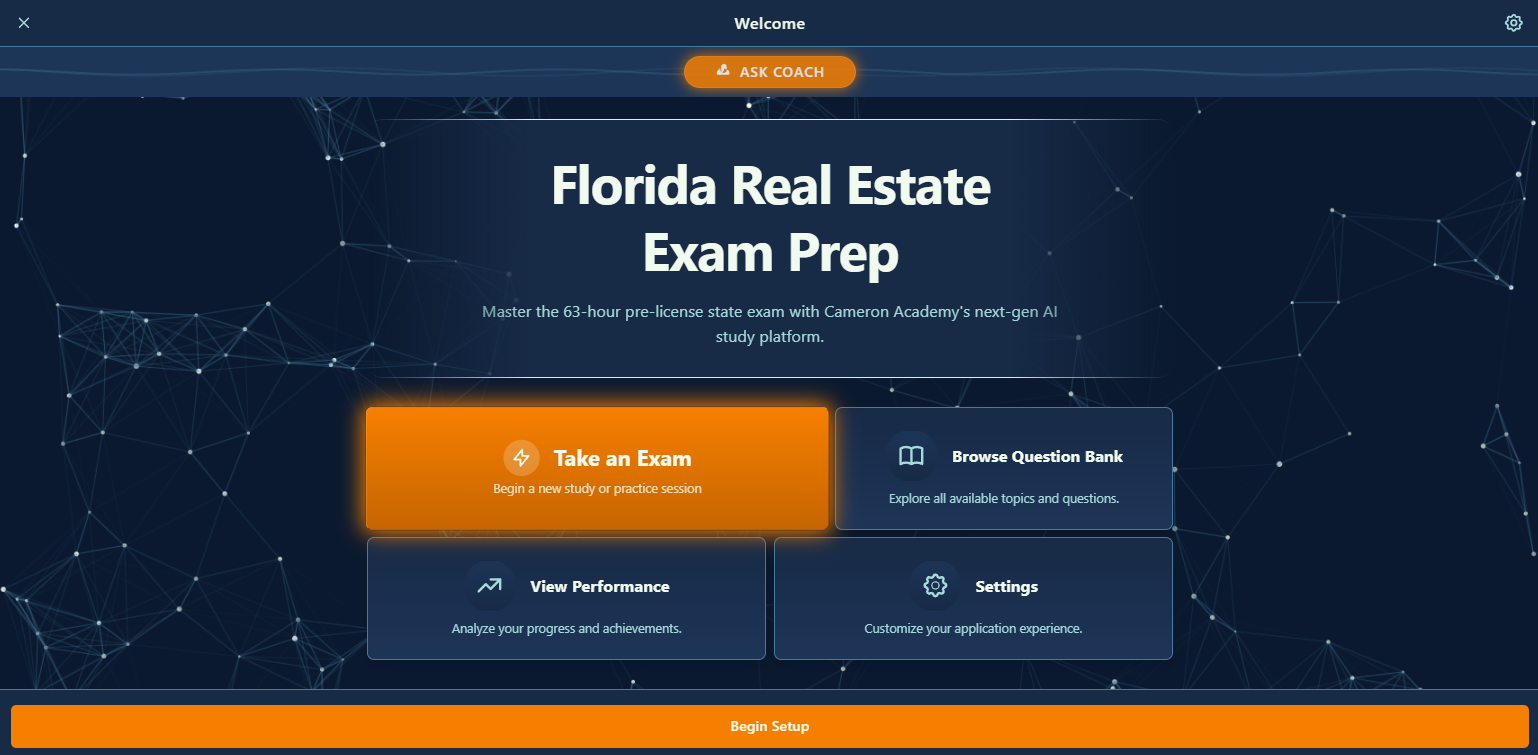
Cameron Academy’s AI Coach uses active recall, spaced repetition, and adaptive question generation — so you’re always studying the thing you’re worst at.
Try It FreeNo credit card required · Cancel anytime
Mix Your Subjects — Don’t “Finish” One First
This one feels wrong, which is exactly why it works.
Interleaved practice — mixing different topics or problem types within a single study session — consistently outperforms blocked practice (doing 50 of the same problem type in a row) in long-term retention studies. The Dunlosky meta-analysis flagged this as a high-impact technique.
The reason is cognitive. When you study the same topic for two hours straight, your brain falls into a pattern. It stops actively deciding which approach to use and starts running on autopilot. When you interleave, every new problem forces your brain to identify what type it is, retrieve the right strategy, and apply it — which mirrors what actually happens during an exam.
Study Less, But Do It Sharper
A 2025 study published in the British Journal of Educational Psychology tracked 231 university students’ daily study habits over 30 days. The finding? Better study strategies compensated for less study time — students who studied with strong planning, concentration, and monitoring needed fewer hours to hit the same achievement levels.
Meanwhile, students who studied many hours with poor concentration experienced the highest levels of negative emotion and stress. More hours, worse mood, same results. Ouch.
per day (even elites)
overestimate study time
work block length
The research from Anders Ericsson on expert performance reinforces this: even elite performers rarely sustain more than four hours of focused practice per day. Most students vastly overestimate their productive hours — what feels like “8 hours at the library” often contains only 4–5 hours of actual focused work.
Quiz Yourself Before You’re “Ready”
This is the testing effect, and it’s one of the most replicated findings in all of cognitive psychology.
Taking a practice test — even when you feel completely unprepared — improves retention more than an equivalent amount of additional study time. The productive struggle of trying to retrieve something and failing at it actually strengthens the eventual memory trace.
The UNC Learning Center puts it well: the moment you feel uncomfortable because you can’t remember the answer is not a sign of failure. It’s the mechanism. That’s the part where learning is actually happening.
Ali Abdaal broke this down brilliantly for his audience — how active recall and spaced repetition combine into a system that’s almost unfairly effective. If you’re still doing the “read → highlight → hope for the best” loop, this video will change how you think about studying forever.
Let AI Handle the Boring Logistics
Here’s what I’ve been building toward: every hack on this list — active recall, spaced repetition, interleaved practice, adaptive quizzing — works brilliantly. But they’re also hard to manage manually.
Spaced repetition requires tracking when you last saw every concept and when you need to see it again. Interleaving requires deliberate session design. Self-quizzing requires generating quality questions. That overhead is why most students default back to re-reading — it’s just easier.
That’s the gap AI fills. Not by replacing studying, but by automating the science behind it. AI-powered study platforms in 2026 can schedule reviews based on your individual recall performance, generate varied question formats from your course materials, identify weak areas automatically and drill you on them, and adapt in real time as you improve.
The students who will win in 2026 are the ones who use AI as a force multiplier for evidence-based study techniques — not as a shortcut to skip the learning process entirely.
TL;DR — What You Need to Know
If there’s one thread running through all nine of these hacks, it’s this: effective studying feels harder than ineffective studying. That’s the paradox. The methods that feel productive — re-reading, highlighting, marathon sessions — produce the weakest results. The methods that feel uncomfortable — self-quizzing, interleaving, teaching out loud — produce the strongest.
The research is stacking up fast in 2026, and the message is clear. It’s not about how many hours you put in. It’s about whether those hours involve your brain actually working — retrieving, struggling, connecting, and consolidating.
Stop studying harder. Start studying like the science says to.


Like the Science Says?
Cameron Academy’s AI exam coach bakes every single one of these strategies into your study sessions automatically. Voice-powered. Gamified. Built on real science.
Start Free TrialNo credit card required · Cancel anytime